CONDITION 2: The existing access to the site for vehicles shall not be used in connection with the development until it has been surfaced with a bound material for a distance of 7.5 metres as measured from the near edge of the public highway, carriageway, and for a width of no less than 3m, in accordance with details to be approved in writing by the Local Planning Authority in consultation with the Highway Authority. CONDITION 3: The development shall not be commenced until space has been provided within the site for the parking of vehicles in accordance with details to be approved in writing by the Local Planning Authority in consultation with the Highway Authority. CONDITION 4: Any Gates erected at the entrance to the site for vehicles shall not be hung so as to open to within 7.5 metres of the near edge of the public highway carriageway. REASON: In the interest of highway safety.
CONDITION 5: No development other than that required to be carried out as part of an approved scheme of remediation shall commence until condition (a) to (d) below have been complied with. If unexpected contamination is found after development has begun, development shall be halted on that part of the site affected by the unexpected contamination to the extent specified in writing by the local planning authority until condition (d) below has been complied with in relation to that contamination. (a) An investigation and risk assessment shall be completed in accordance with a scheme to assess the nature and extent of any contamination on the site, whether or not it originates on the site. The contents of the scheme shall be subject to approval in writing by the local planning authority. The investigation and risk assessment shall be undertaken by competent persons and a written report of the findings shall be produced. The written report shall be subject to approval in writing by the local planning authority. The report of the findings shall include: (i) a survey of the extent, scale and nature of contamination; (ii) an assessment of the potential risks to human health, existing or proposed property and buildings, crops, livestock, pets, woodland and service lines and pipes, adjoining land, groundwaters and surface waters, ecological systems, archaeological sites and ancient monuments; and (iii) an appraisal of remedial options, and proposal of the preferred option(s) to be conducted in accordance with UK Government and the Environment Agency’s Land Contamination Risk Management (LCRM) 8th October 2020. (b) A detailed remediation scheme to bring the site to a condition suitable for the intended use by removing unacceptable risks to human health, buildings and other property and the natural and historical environment shall be prepared and subject to approval in writing by the local planning authority. The scheme shall include all works to be undertaken, proposed remediation objectives and remediation criteria, timetable of works and site management procedures. The scheme shall ensure that the site will not qualify as contaminated land under Part 2A of the Environmental Protection Act 1990 in relation to the intended use of the land after remediation. (c) The approved remediation scheme shall be carried out in accordance with its terms prior to the commencement of development other than that required to carry out remediation. The local planning authority shall be given two weeks written notification of commencement of the remediation scheme works. Following completion of measures identified in the approved remediation scheme, a verification report that demonstrates the effectiveness of the remediation carried out shall be prepared and subject to approval in writing by the local planning authority. (d) In the event that contamination is found at any time when carrying out the development hereby permitted that was not previously identified it shall be reported in writing immediately to the local planning authority. An investigation and risk assessment shall be undertaken in accordance with the requirements of condition (a) and where remediation is necessary a remediation scheme shall be prepared in accordance with the requirements of condition (b) which shall be subject to approval in writing by the local planning authority. Following completion of measures identified in the approved remediation scheme a verification report shall be prepared, which shall be subject to approval in writing by the local planning authority in accordance with condition (c). REASON: To ensure that risks from land contamination to the future users of the land and neighbouring land are minimised, together with those to controlled waters, ecological systems, property and residential amenity and to ensure that the development can be carried out safely without unacceptable risks to workers, neighbours and other offsite receptors.
INFORMATIVE 1: Condition number 1 requires works to be carried out within the limits of the public highway. Before commencing such works the applicant / developer must serve at least 28 days notice under the provisions of Section 184 of the Highways Act 1980 on the Highway Authority‘s Area Team. This process will inform the applicant of the procedures and requirements necessary to carry out works within the Highway and, when agreed, give consent for such works to be carried out under the provisions of S184. In addition, it should be noted that the costs incurred by the County Council in the undertaking of its duties in relation to the construction of the works will be recoverable from the applicant/developer. The Area Team may be contacted by telephone: (01926) 412515. In accordance with Traffic Management Act 2004 it is necessary for all works in the Highway to be noticed and carried out in accordance with the requirements of the New Roads and Streetworks Act 1991 and all relevant Codes of Practice. Before commencing any Highway works the applicant / developer must familiarise themselves with the notice requirements, failure to do so could lead to prosecution. Application should be made to the Street Works Manager, Budbrooke Depot, Old Budbrooke Road, Warwick, CV35 7DP. For works lasting ten days or less, ten days’ notice will be required. For works lasting longer than 10 days, three months’ notice will be required.
INFORMATIVE 2: Section 163 of the Highways Act 1980 requires that water will not be permitted to fall from the roof or any other part of premises adjoining the public highway upon persons using the highway, or surface water to flow – so far as is reasonably practicable – from premises onto or over the highway footway. The developer should, therefore, take all steps as may be reasonable to prevent water so falling or flowing.
INFORMATIVE 3: Pursuant to Section 149 and 151 of the Highways Act 1980, the applicant/developer must take all necessary action to ensure that mud or other extraneous material is not carried out of the site and deposited on the public highway. Should such deposits occur, it is the applicant's/developer's responsibility to ensure that all reasonable steps (e.g. street sweeping) are taken to maintain the roads in the vicinity of the site to a satisfactory level of cleanliness.
INFORMATIVE 4: Prior to commencement of the development, the applicant is required to enter into an agreement with the Highway Authority under Section 59 of the Highways Act 1980. Prior to works taking place on site and following completion of the development, a joint survey shall be undertaken with the County’s Locality Officer to agree the condition of the public highway. Should the public highway be damaged or affected as a consequence of the works being undertaken during the development of the site, the developer will be required to undertake work to remediate this damage as agreed with the Locality Officer.
INFORMATIVE 5: Buildings of all ages and trees with suitable features (i.e. rot-holes, cracks, fissures) are frequently used by roosting bats. Bats and roosts are protected under the 1981 Wildlife and Countryside Act, the Countryside and Rights of Way Act 2000, and The Conservation of Habitat and Species Regulations 2017 (as amended). It is a criminal offence to disturb, obstruct or destroy a bat roost, even if the roost is only occasionally used. Where a bat roost is present a licence may be necessary to carry out any works. Further information about species licensing and legislation can be obtained from the Species Licensing Service on 02080 261089. The applicant is advised that to ensure no bats are endangered during destructive works, the roof tiles should be removed carefully by hand. If evidence of bats is found during works, work should stop immediately and Natural England must be contacted on 02080 261089 for advice on the best way to proceed.
INFORMATIVE 6: Work should avoid disturbance to nesting birds. Birds can nest in many places including buildings, trees, shrubs, dense ivy, and bramble/rose scrub. Nesting birds are protected under the Wildlife and Countryside Act 1981 (as amended). The main nesting season lasts approximately from March to September inclusive, so work should ideally take place outside these dates if at all possible. N.B birds can nest at any time, and the site should ideally be checked by a suitably qualified ecologist for their presence immediately before work starts, especially if during the breeding season.
INFORMATIVE 7: Where possible enhancements should be incorporated into the development to improve the habitats and opportunities for the local wildlife and increase biodiversity. Enhancements could include bat and bird boxes which may be used by a variety of species, native species planting and enhancement of existing of hedges and wild flower planting, habitat piles of rubble, logs and earth which can be used by reptiles, amphibians and invertebrates are also welcomed. The WCC Ecological Services (tel: 01926 418060) would be pleased to advise further if required.
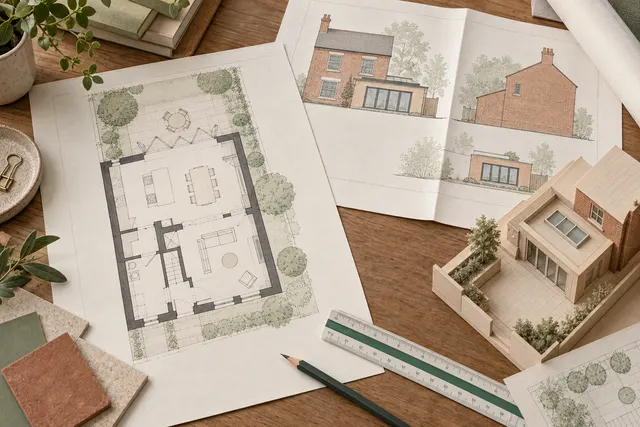
Plans and Documents The Application Form - received 19 June 2026 Existing Ground Floor Plan (25_1405-2007 Rev03) - received 19 June 2026 Existing Elevations (25_1405-2008 Rev03) - received 19 June 2026 Existing Elevations (25_1405-2009 Rev03) - received 19 June 2026 Existing Roof Plan (25_1405-2010 Rev03) - received 19 June 2026 Proposed Plans (25_1405-2002 Rev01) - received 19 June 2026 Proposed Elevations (25_1405-2004 Rev01) - received 19 June 2026 Proposed Elevations (25_1405-2005 Rev01) - received 19 June 2026 Proposed Roof Plan (25_1405-2006 Rev03) - received 19 June 2026 Proposed Site Plan (25_1405-2001 Rev02) - received 19 June 2026 Supporting Statement for Conversion to Residential Dwelling - received 19 June 2026 Structural Appraisal Report - received 19 June 2026
CONDITION 1: The development to which this permission relates must be completed no later than the expiration of three years from the date of this permission. REASON: To comply with Paragraph Q.2 (4) of the General Permitted Development Order (2015) As amended.
Related records
No related records were published in this section.
Understand planning application documents, officer reports and decision notices. Use a reading checklist, document table and worked example to inspect a case.
Understand pending consideration, approved, refused and withdrawn planning applications. Compare status labels and find the documents explaining each outcome.
Read planning drawings, floor plans, elevations and sections. Use labelled diagrams, a drawing comparison table and revision checks to understand a proposal.
 PlanningTrack