CONDITION 1: The development to which this permission relates must not be begun later than the expiration of three years from the date of this permission. REASON 1: To comply with Section 91 of the Town & Country Planning Act 1990 as amended by Section 51 of the Planning and Compulsory Purchase Act, 2004.
CONDITION 2: The development shall be carried out in accordance with the plans and documents detailed below: 84 Newbold Road, Rugby, CV21 2NQ Rev – Design and Access Statement (Received by the Local authority 08/12/2025). Site Location Plan Drg. no – 55 Rev - (Received by the Local authority 15/12/2025). Block Plan Drg. no – 45 Rev- (Received by the Local authority 08/12/2025). Proposed Ground Floor Plan Drg. no – 21 Rev - (Received by the Local authority 08/12/2025). Proposed First Floor Plan Drg. no – 22 Rev - (Received by the Local authority 08/12/2025). Proposed Roof Plan Drg. no – 23 Rev - (Received by the Local authority 08/12/2025). Proposed Front Elevation Drg. no – 25 Rev - (Received by the Local authority 08/12/2025). Proposed Side Elevation Drg. no – 26 Rev - (Received by the Local authority 08/12/2025). Proposed Rear Elevation Drg. no – 27 Rev - (Received by the Local authority 08/12/2025). Proposed Side Elevation Drg. no – 28 Rev - (Received by the Local authority 08/12/2025). REASON 2: For the avoidance of doubt and to ensure that the details of the development are acceptable to the Local Planning Authority.
CONDITION 3: The facing materials to be used on the external walls and roof shall be as specified on the application form, received by the Council on 08/12/2025 and on the plans as listed in condition 2. REASON 3: To ensure a satisfactory external appearance and for the avoidance of doubt.
CONDITION 4: Prior to first occupation, a noise assessment shall be undertaken by a suitably qualified person and be submitted in writing to and approved by the Local Planning Authority. To determine the sound insulation required between the levels. REASON 4: in the interests of residential amenity and to ensure the details are acceptable to the Local Planning Authority
INFORMATIVE: To reduce the likelihood of local residents being subjected to adverse levels of noise annoyance during construction, work on site should not occur outside the following hours: - Monday – Friday 7.30 a.m. – 6.00 p.m. Saturday 8.30 a.m. – 1.00 p.m. NO WORK ON SUNDAYS & BANK HOLIDAYS. If work at other times is required permission should be obtained from the local planning authority
INFORMATIVE: Buildings of all ages and trees with suitable features (i.e. rot-holes, cracks, fissures) are frequently used by roosting bats. Bats and roosts are protected under the 1981 Wildlife and Countryside Act, the Countryside and Rights of Way Act 2000, and The Conservation of Habitat and Species Regulations 2017 (as amended). It is a criminal offence to disturb, obstruct or destroy a bat roost, even if the roost is only occasionally used. Where a bat roost is present a licence may be necessary to carry out any works. Further information about species licensing and legislation can be obtained from the Species Licensing Service on 02080 261089. The applicant is advised that to ensure no bats are endangered during destructive works, the roof tiles should be removed carefully by hand. If evidence of bats is found during works, work should stop immediately and Natural England must be contacted on 02080 261089 for advice on the best way to proceed.
INFORMATIVE: Work should avoid disturbance to nesting birds. Birds can nest in many places including buildings, trees, shrubs, dense ivy, and bramble/rose scrub. Nesting birds are protected under the Wildlife and Countryside Act 1981 (as amended). The main nesting season lasts approximately from March to September inclusive, so work should ideally take place outside these dates if at all possible. N.B birds can nest at any time, and the site should ideally be checked by a suitably qualified ecologist for their presence immediately before work starts, especially if during the breeding season.
INFORMATIVE: Consideration should be given to the provision of suitable bat and bird boxes within the new build or adjacent trees in order to increase opportunities for wildlife. Many bat and bird populations have declined dramatically in recent years due to loss of roost, nest and foraging sites as a result of development. However a variety of bat and bird species use boxes and they can be particularly useful in the built environment, where natural nesting places can be scarce. Further advice and information can be obtained from the Bat Conservation Trust (BCT), and the Royal Society for the Protection of Birds (RSPB).
Understand planning application documents, officer reports and decision notices. Use a reading checklist, document table and worked example to inspect a case.
Understand pending consideration, approved, refused and withdrawn planning applications. Compare status labels and find the documents explaining each outcome.
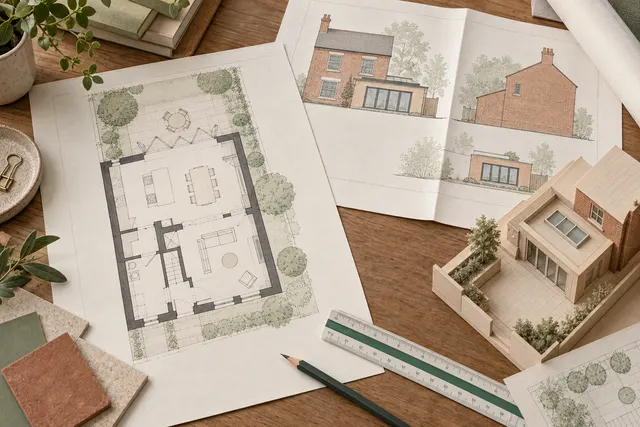
Read planning drawings, floor plans, elevations and sections. Use labelled diagrams, a drawing comparison table and revision checks to understand a proposal.
 PlanningTrack