CONDITION 1: The development to which this permission relates must not be begun later than the expiration of three years from the date of this permission. REASON: To comply with Section 91 of the Town & Country Planning Act 1990 as amended by Section 51 of the Planning and Compulsory Purchase Act, 2004.
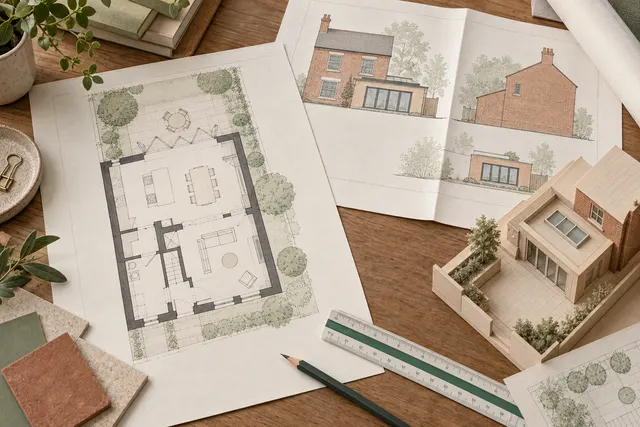
CONDITION 2: The development shall be carried out in accordance with the plans and documents detailed below: - Application Form - Sustainability Checklist Received by Local Planning Authority 25.07.2025 - Site Location Plan (Site_Location_Plan.pdf) Received by Local Planning Authority 28.08.2025 - Existing Site Plan Drg No. A-01-002 Rev 1 - Existing Floor Plans Drg No. A-01-003 Rev 1 - Proposed Floor Plans Drg No. A-01-004 Rev 1 - Proposed Section Drg No. A-01-005 Rev 1 - Existing Elevations Drg No. A-02-006 Rev 1 - Proposed Elevations Drg No. A-02-007 Rev 1 Received by Local Planning Authority 26.09.2025 REASON: For the avoidance of doubt and to ensure that the details of the development are acceptable to the Local Planning Authority.
CONDITION 3: The facing materials to be used on the external walls and roof shall be as specified on the application form, received by the Council on 25.07.2025 and on plans outlined in Condition 2. REASON: To ensure a satisfactory external appearance and for the avoidance of doubt.
CONDITION 4: When carrying out work as part of this development herby permitted, in the event that contamination is found it shall be reported in writing immediately to the local planning authority. Each of the following subsections a) to c) shall then be subject to approval in writing by the local planning authority. a) An investigation and risk assessment shall be undertaken in accordance with a scheme to assess the nature and extent of any contamination on the site, whether or not it originates on the site. b) Where remediation is necessary a detailed remediation scheme to bring the site to a condition suitable for the intended use by removing unacceptable risks to human health, buildings and other property and the natural and historical environment shall be prepared. c) Following completion of measures identified in the approved remediation scheme, a verification report that demonstrates the effectiveness of the remediation carried out shall be prepared and which shall be subject to approval in writing by the local planning authority. REASON: To ensure that risks from land contamination to the future users of the land and neighbouring land are minimised, together with those to controlled waters, ecological systems, property and residential amenity and to ensure that the development can be carried out safely without unacceptable risks to workers, neighbours and other offsite receptors.
INFORMATIVE 1: Bats can be found in many buildings, even those that initially appear to be unsuitable or have been subject to a bat survey and found no evidence. Therefore, if any evidence of bats is found on site, work should stop while a bat survey is carried out by an experienced bat worker, and any recommendations made following the survey are undertaken. It should also be noted that as bats are a mobile species and can move into a property with potential access at any time. A further survey may be required if the works are not undertaken within two years. Bats and roosts are protected under the 1981 Wildlife and Countryside Act, the Countryside and Rights of Way Act 2000, and The Conservation of Habitat and Species Regulations 2017 (as amended).
INFORMATIVE 2: Work should avoid disturbance to nesting birds. Birds can nest in many places including buildings, trees, shrubs dense ivy, and bramble/rose scrub. Nesting birds are protected under the Wildlife and Countryside Act 1981 (as amended). The main nesting season, lasts approximately from March to September, so work should ideally take place outside these dates if at all possible. N.B birds can nest at any time, and the site should ideally be checked for their presence immediately before work starts, especially if during the breeding season.
INFORMATIVE 3: Consideration should be given to the provision of suitable bat and bird boxes within the new build or adjacent trees in order to increase opportunities for wildlife. Many bat and bird populations have declined dramatically in recent years due to loss of roost, nest and foraging sites as a result of development. However, a variety of bat and bird species use boxes and they can be particularly useful in the built environment, where natural nesting places can be scarce. Please ensure that the boxes are appropriately sited and not lit at night in the case of bat boxes. Further advice and information can be obtained from the Bat Conservation Trust (BCT), and the Royal Society for the Protection of Birds (RSPB).
INFORMATIVE 4: The applicant is encouraged to incorporate measures to assist in reducing their impact upon the Air Quality Management Area as part of this development. Initiatives could include the installation of an ultra-low emission boiler (<40mg/kWh) where gas is used for space or water heating, increased tree planting/landscaping, solar thermal panels, and the incorporation of electric vehicle charging points on any car parking. More information on plants that can be incorporated into landscaping for green walls and roofs can be found here: https://www.museumoflondon.org.uk/application/files/4915/2604/2216/2018-05-11-phytosensorfinal-web-ok-compressed_1.pdf Such measures contribute towards improving air quality. Further information can be obtained from Environmental Health on 01788 533857 or email ehcs@rugby.gov.uk Should an Air Source Heat Pump be proposed for installation, it should be ensured that the noise from such plant will not adversely affect residential amenity in the area. These units can create noticeable noise levels which may affect neighbouring dwellings so noise mitigation may be necessary to avoid complaints or possible formal action under other legislation.
INFORMATIVE 5: Environmental Services advise that in order to reduce the likelihood of local residents being subjected to adverse levels of noise annoyance during construction, work on site should not occur outside the following hours: - Monday - Friday - 7.30 a.m. - 6.00 p.m. Saturday - 8.30 a.m. - 1.00 p.m. No work on Sundays & Bank Holidays.
INFORMATIVE 6: Prior to any demolition, redevelopment or refurbishment works taking place an appropriate Asbestos Survey should be undertaken by an asbestos licensed/authorised company/person and any recommendations implemented. For pre-demolition assessment the asbestos survey is fully intrusive and will involve a destructive inspection, as necessary, to gain access to all areas. Where presence of asbestos is suspected the Health and Safety Executive (HSE) and Environment Agency must be notified and special waste regulations complied with; asbestos removal activities fall under the remit of the HSE.
Related records
No related records were published in this section.
Understand planning application documents, officer reports and decision notices. Use a reading checklist, document table and worked example to inspect a case.
Understand pending consideration, approved, refused and withdrawn planning applications. Compare status labels and find the documents explaining each outcome.
Read planning drawings, floor plans, elevations and sections. Use labelled diagrams, a drawing comparison table and revision checks to understand a proposal.
 PlanningTrack