Under Section 96A of the Town and Country Planning Act 1990 (as amended), the revised wording of conditions IS NOT CONSIDERED to constitute a non-material amendment to the development approved under planning permission reference 20/00509/OUT. The non-material amendment as proposed would permit the following: • Removal of the fixed limitation of four B2/B8 units, allowing flexibility in unit numbers and configuration; and • Amendments to Conditions 3 and 4 to enable a phased approach to contamination assessment and remediation, allowing development to come forward on a plot-by-plot basis. Officers have reviewed the proposed amendments and consider that the changes would materially alter the nature and implications of the approved outline permission. Firstly, the proposed amendment to Condition 1 removes the limitation on the number of units. While the overall floorspace would remain the same, this introduces flexibility in how that floorspace could be subdivided and delivered. This has the potential to materially affect the operation and characteristics of the development, including trip generation, servicing patterns, and the distribution of vehicle movements. The original Transport Assessment and subsequent addendum were based on an assumed development scenario, including a defined distribution of B2 and B8 uses across four plots. Any variation in the number of units or the B2/B8 split could alter trip rates, peak movements, and vehicle distribution in a way that has not been assessed. Given known sensitivities in the local highway network and capacity constraints in the area, such changes would require consultation with the Local Highway Authority and potentially National Highways. As such, this cannot reasonably be considered non-material. Secondly, the proposed amendments to Conditions 3 and 4 seek to allow contamination assessment and remediation to be undertaken on a phased, plot-by-plot basis rather than across the site as a whole. The approved conditions require a comprehensive assessment of contamination and associated risks across the entire site prior to development commencing, including risks to human health, property, groundwater, and ecological systems. The site is located on and adjacent to a historic landfill, where there are known risks associated with landfill gas migration and contamination. The original conditions were imposed to ensure that these risks are fully understood and mitigated in a coordinated and comprehensive manner across the whole site. Introducing a phased approach fundamentally alters how these risks would be assessed and managed. Given the complex nature of the site, including its former landfill use and the provision of ecological mitigation and habitat areas, it is necessary to consider contamination and remediation holistically. A phased approach raises potential issues including: • The interaction between phases and the movement of landfill gases or contaminants between plots; • The need to ensure safe access routes and shared areas between phases; • The potential impacts on ecological mitigation areas, including ponds, grassland and woodland; and • The risk that mitigation measures implemented for individual plots could prejudice or complicate subsequent remediation of adjoining land. The acceptability of a phased approach would therefore depend on detailed supporting information, including a comprehensive phasing strategy and site-wide remediation methodology, and would require consultation with Environmental Health and other technical consultees. This goes beyond the scope of a non-material amendment. For the reasons outlined above, the proposed amendments would materially alter both the scope of the development and the way in which key environmental and transport impacts are assessed and controlled. As such, they do not fall within the scope of a non-material amendment under Section 96A. The amendments should be submitted under Section 73 of the Town and Country Planning Act 1990 (as amended) or as part of a new planning application for consideration by the Local Planning Authority. Please note, that this advice is procedural only, and does not give any indication as to the acceptance, or otherwise, of the proposed revision.
Understand planning application documents, officer reports and decision notices. Use a reading checklist, document table and worked example to inspect a case.
Understand pending consideration, approved, refused and withdrawn planning applications. Compare status labels and find the documents explaining each outcome.
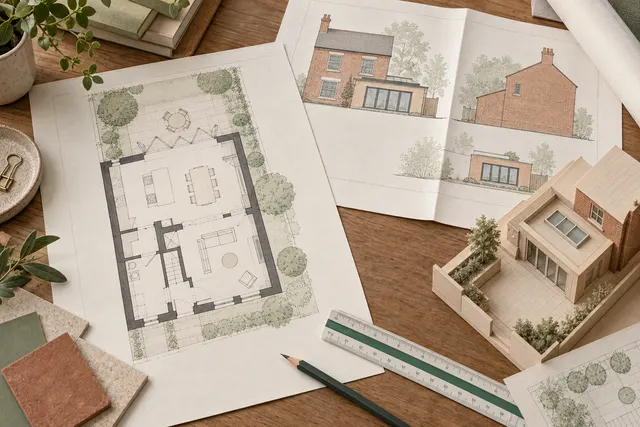
Read planning drawings, floor plans, elevations and sections. Use labelled diagrams, a drawing comparison table and revision checks to understand a proposal.
 PlanningTrack