The development shall be implemented in accordance with the Discussion and Key Recommendations in Section 7 of the Final Report, by Kite Ecology, dated August 2025 and on the drawing 2459 10 – Proposed Elevations and the mitigation measures retained thereafter. Reason: To ensure that animal and plant species and habitats listed under the Conservation of Habitats and Species Regulations 2017 (as amended) and the ecological interests of the site are adequately protected and to accord with policies GN.1 and GN.37 of the Local Development Plan for Pembrokeshire (adopted 28 February 2013) and Section 6 of PPW (Edition 12).
The development shall begin no later than five years from the date of this decision. Reason: To comply with the requirements of Section 91 of the Town & Country Planning Act 1990 (as amended).
The development shall be carried out in accordance with the following approved plans and documents: 2459 01 – Existing Site Plan - Location Plan: 2459 06A – Proposed Site Plan - Location Plan: 2459 07 – Proposed GF Plan: 2549 08 – Proposed FF Plan: 2459 09 – Proposed Elevations & Section Thro: and 2459 10 – Proposed Elevations. Reason: In the interests of amenity and to comply with the requirements of policy GN.1 of the Local Development Plan for Pembrokeshire (Adopted 28th February 2013).
Prior to occupation of the development hereby approved, the proposed bat boxes shall be installed in accordance with the details on drawing 2459 10 – Proposed Elevations and retained thereafter. Reason: In the interests of biodiversity enhancement and to accord with the requirements of policy GN.37 of the Local Development Plan for Pembrokeshire (adopted 28 February 2013).
The wild cherry tree shown on drawing 2459 06A – Proposed Site Plan - Location Plan and detailed within the Green Infrastructure Statement, shall be provided in the first planting and seeding seasons following occupation of the approved development or completion of the development, whichever is sooner and retained thereafter. Reason: To protect and enhance biodiversity interests and to accord with Policies GN.1 and GN.37 of the Local Development Plan for Pembrokeshire (adopted 28 February 2013).
Any external lighting proposed in connection with the extension shall be positioned at a low level, downward facing, hooded and on a short PIR activated timer and retained thereafter. Reason: In the interests of biodiversity and to accord with Policy GN.37 (Protection and Enhancement of Biodiversity) of the Local Development Plan for Pembrokeshire (adopted 28 February 2013).
Having regard to the details of the application proposals, and the relevant provisions of the Local Development Plan for Pembrokeshire (adopted 28 February 2013) as summarised below Policies SP 1, GN.1, GN.2, GN.22 and GN.37. It is considered that subject to compliance with the conditions attached in this permission, the proposed development would be in accordance with the Development Plan. This informative is intended only to be a summary of the reasons for the granting of planning permission. For further details on the decision, please see the application report under the above reference.
This permission shall not be construed as granting rights to carry out works on, or over, land not within the ownership, or control, of the applicant.
You must obtain the prior written consent of the owner and occupier of any land upon which it is necessary for you to enter in order to construct, externally finish, decorate or in any other way carry out any works in connection with this development including future repairs-maintenance, or to obtain support from adjoining property. This permission does not authorise you to take such action without first obtaining this consent. Your attention is also drawn to the Access of Neighbouring Land Act 1992 and Party Wall Act 1996.
This Decision Notice grants planning permission. You are advised that it does not constitute approval under the Building Regulations.
Any existing buildings on site should be assessed for asbestos materials prior to demolition. Any asbestos must be removed in full consultation with the Health and Safety Executive 3rd Floor, Darkgate Buildings, 3 Red Street, Carmarthen, SA31 1QL
This application has been screened in accordance with Natural Resources Wales’ interim advice for planning applications within the river Special Areas of Conservation (SACs) catchments. It is considered that this development is unlikely to increase phosphate and nitrate inputs as it falls within the following criterion in the interim advice: Criterion 3: Development to an existing residential property (e.g. extensions) that does not result in the creation of independent living accommodation, a separate planning unit and-or a change in use, where it can no longer be said to be ancillary to the main residence.
1. The bat survey provided by Kite Ecology identified a small roost for Common Pipistrelle bats within the existing building. On the basis of the information submitted it is considered that a NRW development licence will be required to carry out the works and the following advice will apply. In line with NRW recommendations and their checklist for Low-Risk sites (NRW Approach to Bats and Planning – p5, October 2015): A lower risk case is one where a bat report confirms that bats are present, but NONE of the following apply: 1. Maternity roosts of any bat species regardless of the size of the roost. Please note that some species form small maternity roosts. It is therefore essential that sufficient justification is set out in the bat report to support the assessment of the nature of the use of the roost by bats. 2. Hibernation roosts of any species. 3. Any proposal involving greater horseshoe bat, lesser horseshoe bat, barbastelle bat, Bechsteins bat, grey long-eared bat, Leisler s bat, serotine bat and Nathusius pipistrelle bat. 4. Any proposal involving roost sites for 3 or more different bat species. 5. Any mating or swarming site considered to be important on the basis of the submitted bat report. None of the above checklist apply to this application; therefore, it can be assumed that the favourable conservation status (FCS) of the bat species in question is met. Planning Policy Wales states that to avoid developments with planning permission subsequently not being granted a licence in relation to a European Protected Species (EPS), planning authorities must take the three requirements for a derogation into account when considering development proposals where a EPS is present and must be satisfied a where an EPS licence is required it will be granted by NRW. Any consent must secure the requirements-conditions-information detailed in any NRW response to the application. Licence All British bat species are European Protected Species by virtue of their listing under Annex IV of EC Directive 92/43/EEC (The Habitats Directive). This Directive has been transposed into British Law under the Conservation of Habitats and Species Regulations (2017). As the bat survey revealed the presence of a bat, work may require derogation in the form of a licence from NRW, which the developer has to apply for. Before such a licence can be granted, the following tests (specified in Article 16 of the EU Habitats Directive and in regulation 55 (9) of the 2017 Regulations) must be satisfied: (i) there is no satisfactory alternative to the derogation; (ii) the derogation is not detrimental to the maintenance of the populations of the species concerned at a favourable conservation status in their natural range: (iii) the derogation is in the interests of public health and public safety, or for other imperative reasons of overriding public interest, including those of a social or economic nature and beneficial consequences of primary importance for the environment. This planning permission does not provide consent to undertake works that require an EPS licence. It is an offence to deliberately capture, kill or disturb EPS or to recklessly damage or destroy their breeding sites or resting places. If found guilty of any offences, you could be sent to prison for up to 6 months and-or receive an unlimited fine. To undertake the works within the law, you can obtain further information on the need for a licence from Natural Resources Wales on 0300 065 3000 or at: https://naturalresources.wales/permits-and-permissions/protected-species-licensing/european-protected-species-licensing/information-on-european-protected-species-licensing/?lang=en
Understand planning application documents, officer reports and decision notices. Use a reading checklist, document table and worked example to inspect a case.
Understand pending consideration, approved, refused and withdrawn planning applications. Compare status labels and find the documents explaining each outcome.
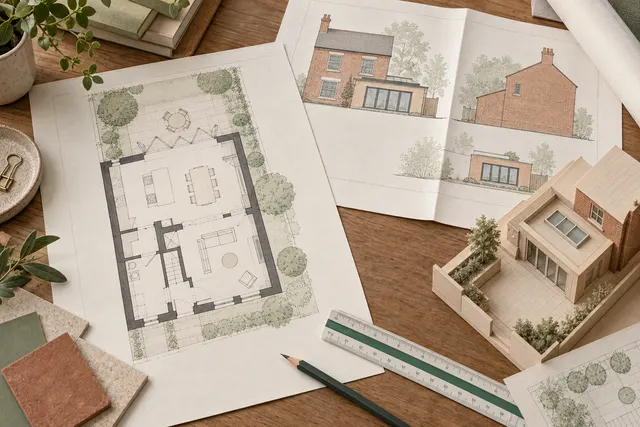
Read planning drawings, floor plans, elevations and sections. Use labelled diagrams, a drawing comparison table and revision checks to understand a proposal.
 PlanningTrack