The development shall begin no later than five years from the date of this decision. Reason: To comply with the requirements of Section 91 of the Town & Country Planning Act 1990 (as amended).
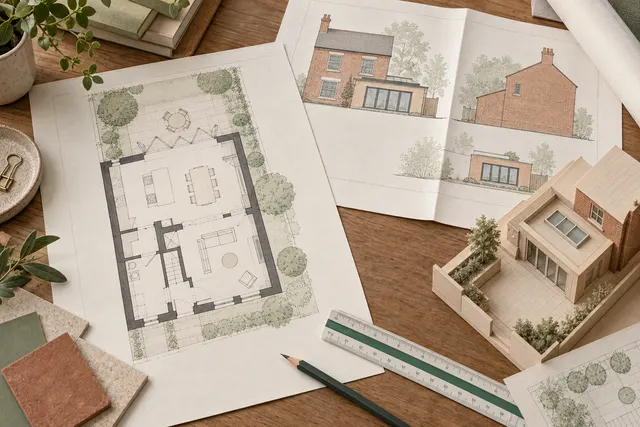
The development shall be carried out in accordance with the following approved plans and documents: Supporting planning statement, dated 4th of August 2025 2501, P-02, Block plans, receieved 21st of August 2025 2501, P-03, Proposed floor plans, receieved 21st of August 2025 2501, P-04, Elevations, receieved 21st of August 2025 2501, P-07, Proposed single garage plans, receieved 21st of August 2025 I&G Ecologcal Consulting, Bat report, receieved 21st of August 2025 Coal Mining Risk Assessment Report, dated October 2025 Reason: In the interests of amenity and to comply with the requirements of policy GN.1 of the Local Development Plan for Pembrokeshire (Adopted 28th February 2013).
Notwithstanding the information contained within the application, no above ground development shall commence until an intrusive investigations has been undertaken. Details of remedial works and mitigatory measures is to be submitted to and agreed in writing by the local planning authority. The scheme shall be implemented in accordance with the approved details. Reason: To ensure the development would not pose any risk by past coal mining activity and cause unacceptable harm to health and safety, and to accord with policies GN.1 and GN.2 of the Local Development Plan for Pembrokeshire (adopted 28 February 2013).
The development hereby permitted shall take place in strict accordance with the bat mitigation recommendations outlined in Section 5.1 of the submitted Bat Report by I&G Ecological Consulting, receieved 21st of August 2025. Reason: To accord with the duty to safeguard protected species in compliance with policies GN.1 and GN.37 of the Local Development for Pembrokeshire (Adopted 28th February 2013).
Prior to the commencement of the development, the result of percolation testing shall be submitted to and approved by the Local Planning Authority to ensure that the proposed drainage can be implemented. If the results determine that the proposed SuDS system will not work, a revised drainage strategy will also need to be submitted and approved. Such scheme as is approved shall be implemented and retained thereafter. Reason: In order to ensure the scheme does not cause surface water flooding and to accord with policy GN.1 of the Local Development Plan for Pembrokeshire (adopted 28 February 2013) and with Schedule 3 of the Flood and Water Management Act 2010.
The off-street parking facilities (for all vehicles, including cycles) shown on the drawing no. 2501, P-02, Block plans, received 21st of August 2025 hereby approved shall be provided before the building is first occupied, and thereafter retained for that purpose. Reason: To ensure the satisfactory provision of parking facilities and in the interest of highway safety and the amenity of the area, and to accord with Policy GN.1 of the Local Development Plan for Pembrokeshire (adopted 28 February 2013).
The provision of green infrastructure detailed in the Green Infrastructure Statement and on drawing 2501, P-02, Block plans, received 21st August 2025, shall be carried out in the first planting season following occupation of the dwelling or completion of the development, whichever is sooner. Any plants or trees which within a period of 5 years from completion of the development die, are removed or become seriously damaged or diseased shall be replaced in the next planting season with others of a similar size and species. Reason: To protect the wildlife and the ecological interests of the site, in accordance with policies GN.1 and GN.37 of the Local Development Plan for Pembrokeshire (adopted 28 February 2013).
Having regard to the details of the application proposals, and the relevant provisions of the Local Development Plan for Pembrokeshire (adopted 28 February 2013) as summarised below • Policies SP 1 (Sustainable Development), SP 16 (The Countryside), GN.1 (General Development Policy), GN.2 (Sustainable Design), GN.26 (Residential Development) and GN.37 (Protection and Enhancement of Biodiversity). It is considered that subject to compliance with the conditions attached in this permission, the proposed development would be in accordance with the Development Plan. This informative is intended only to be a summary of the reasons for the granting of planning permission. For further details on the decision, please see the application report under the above reference.
This permission shall not be construed as granting rights to carry out works on, or over, land not within the ownership, or control, of the applicant.
You must obtain the prior written consent of the owner and occupier of any land upon which it is necessary for you to enter in order to construct, externally finish, decorate or in any other way carry out any works in connection with this development including future repairs/maintenance, or to obtain support from adjoining property. This permission does not authorise you to take such action without first obtaining this consent. Your attention is also drawn to the Access of Neighbouring Land Act 1992 and Party Wall Act 1996.
This Decision Notice grants planning permission. You are advised that it does not constitute approval under the Building Regulations.
The proposed development lies within an area that has been defined by the Mining Remediation Authority as containing potential hazards arising from former coal mining activity at the surface or shallow depth. These hazards can include: mine entries (shafts and adits); shallow coal workings; geological features (fissures and break lines); mine gas and former surface mining sites. Although such hazards are seldom readily visible, they can often be present and problems can occur in the future, particularly as a result of new development taking place. It is recommended that information outlining how former mining activities may affect the proposed development, along with any mitigation measures required (for example the need for gas protection measures within the foundations), is submitted alongside any subsequent application for Building Regulations approval (if relevant). Any form of development over or within the influencing distance of a mine entry can be dangerous and raises significant land stability and public safety risks. As a general precautionary principle, the Coal Authority considers that the building over or within the influencing distance of a mine entry should be avoided. In exceptional circumstance where this is unavoidable, expert advice must be sought to ensure that a suitable engineering design which takes into account all the relevant safety and environmental risk factors, including mine gas and mine-water. Your attention is drawn to the Coal Authority Policy in relation to new development and mine entries available at: www.gov.uk/government/publications/building-on-or-within-the-influencing-distance-of-mine-entries Any intrusive activities which disturb or enter any coal seams, coal mine workings or coal mine entries (shafts and adits) requires a Coal Authority Permit. Such activities could include site investigation boreholes, excavations for foundations, piling activities, other ground works and any subsequent treatment of coal mine workings and coal mine entries for ground stability purposes. Failure to obtain a Coal Authority Permit for such activities is trespass, with the potential for court action. If any coal mining features are unexpectedly encountered during development, this should be reported immediately to the Mining Remediation Authority on 0345 762 6848. Further information is available on the Mining Remediation Authority website at: www.gov.uk/government/organisations/the-coal-authority
A European protected species (EPS) Licence is required for this development. It is an offence to deliberately capture, kill or disturb EPS or to damage or destroy their breeding sites or resting places. If found guilty of any offences, you could be sent to prison for up to 6 months and/or receive an unlimited fine. To undertake the works within the law, you can obtain further information on the need for a licence from Natural Resources Wales on 0300 065 3000 or at Natural Resources Wales / Apply for a protected species licence. Development should not be commenced until the Applicant has been granted a licence by Natural Resources Wales pursuant to Regulation 55 of the Conservation of Habitats and Species Regulations (2017) authorizing the specified activity/development to go ahead. Please note that any changes to plans between planning consent and the licence application may affect the outcome of a licence application.
Foul Drainage Applicants wishing to operate a private sewerage system will need either to apply to us for an environmental permit or register with us for an exemption from the permit requirement. Septic tanks and small sewage treatment works that meet certain criteria may be registered as exempt. Where private sewage treatment/disposal facilities are utilised, they must be installed and maintained in accordance with British Standard 6297 and Approved Document H of the Building Regulations. We also refer the Applicant to Guidance for Pollution Prevention 4 on the NetRegs website (https://www.netregs.org.uk/media/1887/guidance-for-pollution-prevention-4-2022-update.pdf), which provides further information.
From 7th January 2019, all new developments of more than 1 property or where the construction area that has drainage implications is 100 square meters or more, will require sustainable drainage systems (SuDS) for surface water. The SuDS must be designed and built in accordance with Statutory SuDS Standards published by the Welsh Ministers and SuDS Schemes must be approved by the local authority acting in its SuDS Approving Body (SAB) role, before construction work begins. Pembrokeshire County Council as SuDS Approving Body (SAB) considers that by virtue of the fact that the construction area having drainage implications appears to be in excess of 100 square metres, the proposed works will require SAB approval prior to the commencement of any works on site relating to this application. The applicant can obtain further information in relation to the SAB approval process from the Authorities website at www.pembrokeshire.gov.uk/planning-contacts/sustainable-drainage-approving-body-sab Please contact: SAB Community Services Directorate Infrastructure Division Pembrokeshire County Council County Hall Haverfordwest Pembrokeshire SA61 1TP e-mail: sab@pembrokeshire.gov.uk The SAB team can be contacted by telephone as follows: 01437 776147.
A number of footpaths surround the site, the developer must ensure that: 1. There is no diminution in the width of the right of way available for use by members of the public 2. No building materials are stored on the right of way 3. No damage or substantial alterations, either temporary or permanent, is caused to the surface of the right of way 4. Vehicle movements are arranged so as not to interfere with the public’s use of the way 5. No additional barriers (e.g. gates) are to be placed across the right of way, of either a temporary or permanent nature 6. No wildlife fencing or other ecological protection features associated with wildlife mitigation measures are placed across the right of way or allowed to interfere with the right of way 7. The safety of members of the public using the right of way is ensured at all times 8. The granting of planning consent does not authorise lawful authority to drive a motor vehicle on a public right of way. Developers/landholders should ensure that public use of the Public Right of Way takes precedence over private vehicular traffic. It is a criminal offence to damage the surface of a Public Right of Way, and the consent of the County Council must be sought for the route to be re-surfaced even if the surface is to be improved. The granting of planning permission for development of land over which there is a public right of way does not itself constitute authority for interference with the right of way or for its closure or diversion.
Notwithstanding the information contained within the application, no development shall commence until details of a scheme for the disposal of foul water has been submitted to and approved in writing by the local planning authority. The scheme shall include suitability of ground conditions for the proposed methods of water disposal. The scheme shall be implemented in accordance with the approved details prior to first occupation and retained for as long as the development exists. Reason: To ensure that a satisfactory means of foul water drainage is provided, and to accord with policies GN.1 and GN.2 of the Local Development Plan for Pembrokeshire (adopted 28 February 2013).
Understand planning application documents, officer reports and decision notices. Use a reading checklist, document table and worked example to inspect a case.
Understand pending consideration, approved, refused and withdrawn planning applications. Compare status labels and find the documents explaining each outcome.
Read planning drawings, floor plans, elevations and sections. Use labelled diagrams, a drawing comparison table and revision checks to understand a proposal.
 PlanningTrack