The development shall begin no later than five years from the date of this decision. Reason: To comply with the requirements of Section 91 of the Town & Country Planning Act 1990 (as amended).
The development shall be carried out in accordance with the following approved plans and documents: Block Plan and Site Location Plan 25030/100 Rev E, Proposed layout Drawing 25030/02 Rev E, Ecology report by Kite Ecology dated August 2025, Design and Access Statement, Green Infrastructure Statement. Reason: In the interests of amenity and to comply with the requirements of policy GN1 of the Local Development for Pembrokeshire (Adopted 28th February 2013).
A bat box shall be installed prior to the substantial completion of the extension hereby permitted and retained thereafter. Reason: In order to comply with The Environment (Wales) Act 2016 to maintain and enhance biodiversity, in accordance with policies GN.1 and GN.37 of the Local Development Plan for Pembrokeshire (adopted 28 February 2013).
The development hereby permitted shall take place in strict accordance with the bat mitigation recommendations outlined in Sections 4 of the submitted Bat Report by Kite Ecology. Reason: In order to comply with The Environment (Wales) Act 2016 to maintain and enhance biodiversity, in accordance with policies GN.1 and GN.37 of the Local Development Plan for Pembrokeshire (adopted 28 February 2013).
This application has been screened in accordance with Natural Resources Wales interim advice to Chief Planners dated 25th July 2025. It is considered that this development is unlikely to have a likely significant effect on the Marine SAC as the following criterion applies: No. 1 Any development that does not increase the volume or concentration of wastewater.
The proposed development lies within an area that has been defined by the Mining Remediation Authority as containing coal mining features at surface or shallow depth. These features may include: mine entries (shafts and adits); shallow coal workings; geological features (fissures and break lines); mine gas and former surface mining sites. Although such features are seldom readily visible, they can often be present and problems can occur, particularly as a result of new development taking place. Any intrusive activities which disturb or enter any coal seams, coal mine workings or coal mine entries (shafts and adits) requires a Mining Remediation Authority Permit. Such activities could include site investigation boreholes, excavations for foundations, piling activities, other ground works and any subsequent treatment of coal mine workings and coal mine entries for ground stability purposes. Application forms for Mining Remediation Authority permission and further guidance can be obtained from The Mining Remediation Authority’s website at: www.gov.uk/get-a-permit-to-deal-with-a-coal-mine-on-your-property What is a permit and how to get one? – https://www.gov.uk/government/publications/permit-process/permit-process In areas where shallow coal seams are present caution should be taken when carrying out any on site burning or heat focused activities. If any future development has the potential to encounter coal seams which require excavating, for example excavation of building foundations, service trenches, development platforms, earthworks, non-coal mineral operations, an Incidental Coal Agreement will be required. Further information regarding Incidental Coal Agreements can be found here – https://www.gov.uk/government/publications/incidental-coal-agreement/guidance-notes-for-applicants-for-incidental-coal-agreements If any coal mining features are unexpectedly encountered during development, this should be reported immediately to the Mining Remediation Authority on 0800 288 4242. Further information is available on the Mining Remediation Authority website at: https://www.gov.uk/government/organisations/mining-remediation-authority.
Understand planning application documents, officer reports and decision notices. Use a reading checklist, document table and worked example to inspect a case.
Understand pending consideration, approved, refused and withdrawn planning applications. Compare status labels and find the documents explaining each outcome.
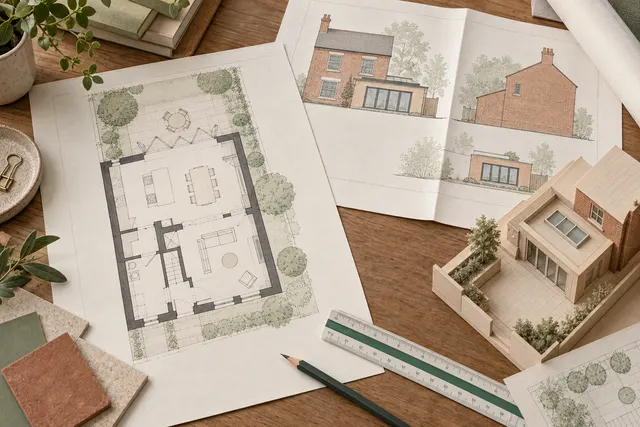
Read planning drawings, floor plans, elevations and sections. Use labelled diagrams, a drawing comparison table and revision checks to understand a proposal.
 PlanningTrack