The development hereby permitted shall be carried out in accordance with the following approved plans and documents, where applicable. Received 26 June 2026: - Application Form - Community Infrastructure Levy form - PLANNING, DESIGN AND ACCESS STATEMENT - 250820-DWG-001 rev. A - 250820-DWG-002 rev. A - 250820-DWG-003 rev. A - Tree Survey/Arboricultural Report Received 01 July 2026: - FRA - Statement of Use/RES REASON: To accord with the terms of the application, for the avoidance of doubt and in the interests of proper planning.
The development to which this permission relates must be begun not later than the expiration of three years beginning with the date of this permission. REASON: To conform with the requirements of Section 91 of the Town and Country Planning Act 1990 as amended by the Planning and Compulsory Purchase Act 2004.
No new external finishes (including fenestration), including works of making good, shall be carried out other than in materials to match the existing, except where indicated otherwise on the submitted application form and/or approved drawings. REASON: To ensure that the proposed development is in keeping with the existing building and does not prejudice the appearance of the locality.
The outbuilding is to be used as ancillary to the existing dwelling on site only, and shall at no time be used as a separate dwelling unit or subdivided. REASON: To safeguard the amenities of nearby occupiers and the area generally.
The development hereby approved shall not be implemented other than in accordance with the principles and methodology as described within the approved Arboricultural details Arboricultural Impact Assessment Method Statement & Tree Protection Plan (to BS:5837 2012) Date: 16th March 2026 Ref: TH 5907, unless otherwise previously agreed in writing with the Local Planning Authority. REASON: To ensure that the tree (s) are not damaged or otherwise adversely affected by demolition, building operations, excavations and soil compaction.
(A) No development shall take place until full details of soft landscaping works and tree planting have been submitted to and approved in writing by the local planning authority. Such details to include: 1. Planting plans, written specifications (including cultivation and other operations associated with plant and grass establishment); 2. Planting methodology; 3. Specification of the quantity, density, size, species, position and the proposed time or programme of planting; 4. Details of earthworks, to include the proposed grading and mounding of land areas including the levels and contours to be formed, showing the relationship of proposed mounding to existing vegetation and surrounding landform; 5. A 3-year maintenance and management programme.[RC1.1] (B) This scheme shall be written in accordance with the British Standard 5837:2012 Trees in relation to design, demolition and construction – Recommendations (sections 5.6) and BS 8545:2014 Trees: from nursery to independence in the landscape. Recommendations. (C) All tree/plant/shrub planting included within the approved specification shall be carried out in accordance with that specification and in accordance with BS 3936-1:1992 (Nursery Stock. Specification for trees and shrubs) BS3936-4:2007, Specification for forest trees); BS 4043: 1989, Transplanting root-balled trees; and BS 4428:1989, Code of practice for general landscape operations (excluding hard surfaces). (D) All soft landscaping works and tree planting shall be carried out in accordance with the approved details and in any event prior to the occupation of any part of the development, unless otherwise agreed in writing with the Local Planning Authority. (E) If within a period of 5 years from the date of planting of any tree that tree, or any tree planted in replacement for it, is removed, uprooted, destroyed or dies, (or becomes in the opinion of the local planning authority seriously damaged or defective), another tree of the same species and size originally planted shall be planted at the same place in the next planting season/within one year of the original tree’s demise unless the local planning authority gives its written consent to any variations. REASON: To ensure that the proposed development does not prejudice the appearance of the locality and to preserve and enhance nature conservation interests of the site.
Approval of a Biodiversity Gain Plan will not be required before development commences Biodiversity Net Gain The effect of paragraph 13 of Schedule 7A to the Town and Country Planning Act 1990 is that planning permission granted for development of land in England is deemed to have been granted subject to the condition ('biodiversity gain condition') that development may not begin unless: (a) a Biodiversity Gain Plan has been submitted to the planning authority, and (b) the planning authority has approved the plan. The planning authority, for the purposes of determining whether to approve a Biodiversity Gain Plan, if one is required in respect of this permission would be the London Borough of Richmond upon Thames. There are statutory exemptions and transitional arrangements which mean that the biodiversity gain condition does not always apply. These are listed below. Based on the information available this permission is considered to be one which will not require the approval of a biodiversity gain plan before development is begun because one or more of the statutory exemptions or transitional arrangements in the list below is/are considered to apply. Statutory exemptions and transitional arrangements in respect of the biodiversity gain condition. 1. The application for planning permission was made before 12 February 2024. 2. The planning permission relates to development to which section 73A of the Town and Country Planning Act 1990 (planning permission for development already carried out) applies. 3. The planning permission was granted on an application made under section 73 of the Town and Country Planning Act 1990 and (i) the original planning permission to which the section 73 planning permission relates* was granted before 12 February 2024; or (ii) the application for the original planning permission* to which the section 73 planning permission relates was made before 12 February 2024. 4. The permission which has been granted is for development which is exempt being: 4.1 Development which is not 'major development' (within the meaning of article 2(1) of the Town and Country Planning (Development Management Procedure) (England) Order 2015) where: (i) the application for planning permission was made before 2 April 2024; (ii) planning permission is granted which has effect before 2 April 2024; or (iii) planning permission is granted on an application made under section 73 of the Town and Country Planning Act 1990 where the original permission to which the section 73 permission relates* was exempt by virtue of (i) or (ii). 4.2 Development below the de minimis threshold, meaning development which: (i) does not impact an onsite priority habitat (a habitat specified in a list published under section 41 of the Natural Environment and Rural Communities Act 2006); and (ii) impacts less than 25 square metres of onsite habitat that has biodiversity value greater than zero and less than 5 metres in length of onsite linear habitat (as defined in the statutory metric). 4.3 Development which is subject of a householder application within the meaning of article 2(1) of the Town and Country Planning (Development Management Procedure) (England) Order 2015. A 'householder application' means an application for planning permission for development for an existing dwellinghouse, or development within the curtilage of such a dwellinghouse for any purpose incidental to the enjoyment of the dwellinghouse which is not an application for change of use or an application to change the number of dwellings in a building. 4.4 Development of a biodiversity gain site, meaning development which is undertaken solely or mainly for the purpose of fulfilling, in whole or in part, the Biodiversity Gain Planning condition which applies in relation to another development, (no account is to be taken of any facility for the public to access or to use the site for educational or recreational purposes, if that access or use is permitted without the payment of a fee). 4.5 Self and Custom Build Development, meaning development which: (i) consists of no more than 9 dwellings; (ii) is carried out on a site which has an area no larger than 0.5 hectares; and (iii) consists exclusively of dwellings which are self-build or custom housebuilding (as defined in section 1(A1) of the Self-build and Custom Housebuilding Act 2015). 4.6 Development forming part of, or ancillary to, the high speed railway transport network (High Speed 2) comprising connections between all or any of the places or parts of the transport network specified in section 1(2) of the High Speed Rail (Preparation) Act 2013. * 'original planning permission means the permission to which the section 73 planning permission relates' means a planning permission which is the first in a sequence of two or more planning permissions, where the second and any subsequent planning permissions are section 73 planning permissions. Irreplaceable habitat If the onsite habitat includes irreplaceable habitat (within the meaning of the Biodiversity Gain Requirements (Irreplaceable Habitat) Regulations 2024) there are additional requirements for the content and approval of Biodiversity Gain Plans. The Biodiversity Gain Plan must include, in addition to information about steps taken or to be taken to minimise any adverse effect of the development on the habitat, information on arrangements for compensation for any impact the development has on the biodiversity of the irreplaceable habitat. The planning authority can only approve a Biodiversity Gain Plan if satisfied that the adverse effect of the development on the biodiversity of the irreplaceable habitat is minimised and appropriate arrangements have been made for the purpose of compensating for any impact which do not include the use of biodiversity credits. The effect of section 73D of the Town and Country Planning Act 1990 If planning permission is granted on an application made under section 73 of the Town and Country Planning Act 1990 (application to develop land without compliance with conditions previously attached) and a Biodiversity Gain Plan was approved in relation to the previous planning permission ('the earlier Biodiversity Gain Plan') there are circumstances when the earlier Biodiversity Gain Plan is regarded as approved for the purpose of discharging the biodiversity gain condition subject to which the section 73 planning permission is granted. Those circumstances are that the conditions subject to which the section 73 permission is granted: (i) do not affect the post-development value of the onsite habitat as specified in the earlier Biodiversity Gain Plan, and (ii) in the case of planning permission for a development where all or any part of the onsite habitat is irreplaceable habitat the conditions do not change the effect of the development on the biodiversity of that onsite habitat (including any arrangements made to compensate for any such effect) as specified in the earlier Biodiversity Gain Plan.
In accordance with Section DM3 of the National Planning Policy Framework, Richmond upon Thames Borough Council takes a positive and proactive approach to the delivery of sustainable development, by: * Providing a formal pre-application service * Providing written policies and guidance, all of which is available to view on the Council's website * Where appropriate, negotiating amendments to secure a positive decision * Determining applications in a timely manner. In this instance: * The application was acceptable as submitted, and approved without delay * The application was amended following negotiations with the Council to ensure the scheme complied with adopted policy and guidance, and a decision was made without delay * The application was recommended for approval and referred to the first available Planning Committee, where the agents / applicants had an opportunity to present the case.
Understand planning application documents, officer reports and decision notices. Use a reading checklist, document table and worked example to inspect a case.
Understand pending consideration, approved, refused and withdrawn planning applications. Compare status labels and find the documents explaining each outcome.
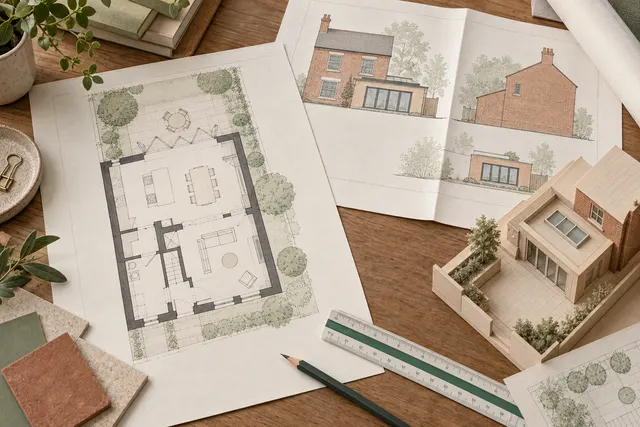
Read planning drawings, floor plans, elevations and sections. Use labelled diagrams, a drawing comparison table and revision checks to understand a proposal.
 PlanningTrack