The proposals constitute permitted development, by virtue of Schedule 2, Part 14, Class J of the Town and Country Planning (General Permitted Development) Order 2015 (as amended).
Redbridge Planning Service adopts a positive and proactive approach when engaging with applicants/agents in line with the National Planning Policy Framework. We encourage engagement with the pre-application service to avoid delays in the planning process. https://www.redbridge.gov.uk/planning-and-building/planning/
The applicant should be aware that Building Regulations approval will be required for most types of building work. Please see information and how to apply for Building Regulation consent at: https://www.redbridge.gov.uk/planning-and-building/building-control/ or for further assistance contact the Building Control Section. e-mail: Buildingcontrol@redbridge.gov.uk Telephone: 020 8708 2529.
The development is subject to the conditions set out in Schedule 2 Part 14 Class J of the General Permitted Development Other (2015) as amended: Conditions J.4- (1) Class J development is permitted subject to the following conditions- (a) the solar PV equipment or solar thermal equipment must, so far as practicable, be sited so as to minimise its effect on the external appearance of the building and the amenity of the area; and (b) the solar PV equipment or solar thermal equipment is removed as soon as reasonably practicable when no longer needed. (2) Class J(c) development is permitted subject to the condition that before beginning the development the developer must apply to the local planning authority for a determination as to whether the prior approval of the authority will be required as to the design or external appearance of the development, in particular the impact of glare on occupiers of neighbouring land, and the following sub-paragraphs apply in relation to that application. (3) The application must be accompanied by- (a) a written description of the proposed development; (b) a plan indicating the site and showing the proposed development; (c) the developer's contact address; and (d) the developer's email address if the developer is content to receive communications electronically; together with any fee required to be paid. (4) The local planning authority may refuse an application where, in the opinion of the authority- (a) the proposed development does not comply with, or (b) the developer has provided insufficient information to enable the authority to establish whether the proposed development complies with, any conditions, limitations or restrictions specified in Class J applicable to the development in question. (5) Sub-paragraphs (6) and (8) do not apply where a local planning authority refuses an application under sub-paragraph (4) and for the purposes of section 78 (appeals) of the Act such a refusal is to be treated as a refusal of an application for approval. (6) The local planning authority must give notice of the proposed development- (a) by site display in at least one place on or near the land to which the application relates for not less than 21 days of a notice which- (i) describes the proposed development; (ii) provides the address of the proposed development; (iii) specifies the date by which representations are to be received by the local planning authority; or (b) by serving a notice in that form on any adjoining owner or occupier. (7) The local planning authority may require the developer to submit such information as the authority may reasonably require in order to determine the application. (8) The local planning authority must, when determining an application- (a) take into account any representations made to them as a result of any notice given under sub-paragraph (6); and (b) have regard to the National Planning Policy Framework issued by the Ministry of Housing, Communities and Local Government in July 2021, so far as relevant to the subject matter of the prior approval, as if the application were a planning application. (9) The development must not begin before the occurrence of one of the following- (a) the receipt by the applicant from the local planning authority of a written notice of their determination that such prior approval is not required; (b) the receipt by the applicant from the local planning authority of a written notice giving their prior approval; or (c) the expiry of 56 days following the date on which the application under sub-paragraph (3) was received by the local planning authority without the authority notifying the applicant as to whether prior approval is given or refused. (10) The development must be carried out- (a) where prior approval is required, in accordance with the details approved by the local planning authority; (b) where prior approval is not required, or where sub-paragraph (9)(c) applies, in accordance with the details provided in the application referred to in sub-paragraph (3), unless the local planning authority and the developer agree otherwise in writing. (11) The local planning authority may grant prior approval unconditionally or subject to conditions reasonably related to the subject matter of the prior approval. (12) When computing the number of days in paragraph (6)(a), any day which is a public holiday must be disregarded.
Understand planning application documents, officer reports and decision notices. Use a reading checklist, document table and worked example to inspect a case.
Understand pending consideration, approved, refused and withdrawn planning applications. Compare status labels and find the documents explaining each outcome.
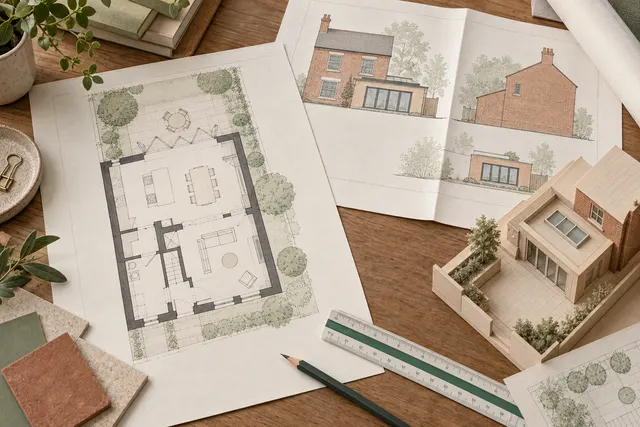
Read planning drawings, floor plans, elevations and sections. Use labelled diagrams, a drawing comparison table and revision checks to understand a proposal.
 PlanningTrack