The development hereby permitted shall be begun before the expiration of three years from the date of this permission. REASON: To comply with Section 91(1) of the Town and Country Planning Act, 1990 as amended by Section 51 of the Planning and Compulsory Purchase Act 2004.
The development hereby permitted shall be carried out in accordance with the following approved plans: 0029-A101; 0029-A102; 0029-A103 and Location Plan REASON: For the avoidance of doubt and in the interests of proper planning.
The premises shall be used as a residential care home for three children and for no other purpose, including any other purpose in Use Class C2 of the Schedule to the Town and Country Planning (Use Classes) Order 1987 (as amended), or in any provision equivalent to that class in any statutory instrument revoking or re-enacting that Order with or without modification. REASON: In the interests of amenity and to comply with Borough Development Strategy 2017 Policy L1 Housing Development, extensions and alterations to existing dwellings Policy D2 Incompatible Land Uses (in part) and Policy L8 Protecting the Viability and Integrity of Industrial and Business Uses (in part) Policy D2 Incompatible Land Uses (in part). Informative In dealing with this application the Local Planning Authority have worked with the applicant in a positive, proactive and creative manner, seeking solutions to problems arising in relation to dealing with the application, by seeking to help the applicant resolve technical detail issues where required and maintaining the delivery of sustainable development. The development would improve the economic, social and environmental concerns of the area and thereby being in accordance with paragraph 39 of the National Planning Policy Framework 2024. Informative: Biodiversity Net Gain Requirements When granting planning permission, Article 35 of the Town and Country Planning (Development Management Procedure) (England) Order 2015 (as amended by The Biodiversity Gain (Town and Country Planning) (Modifications and Amendments) (England) Regulations 2024) (https://www.legislation.gov.uk/uksi/2015/595/article/35/) requires planning authorities to set out the following information to signpost an applicant to the statutory framework for Biodiversity Net Gain. Paragraph 13 of Schedule 7A to the Town and Country Planning Act 1990 states that planning permission, granted for the development of land in England, is deemed to have been granted subject to the "Biodiversity Gain condition" and that development may not begin unless: (a) a Biodiversity Gain Plan has been submitted to the planning authority, and (b) the planning authority has approved the plan. The planning authority, for the purposes of determining whether to approve a Biodiversity Gain Plan if one is required in respect of this permission is the Dudley Metropolitan Borough Council. In accordance with the Biodiversity Net Gain Planning Practice Guidance, the Biodiversity Gain condition is not being repeated within this decision notice. However, please be aware that noncompliance with this statutory condition may result in enforcement action. There are statutory exemptions and transitional arrangements which mean that the Biodiversity Gain condition does not always apply. These are set out in The Biodiversity Gain Requirements (Exemptions) Regulations 2024 (https://www.legislation.gov.uk/uksi/2024/47/contents/made) and The Environment Act 2021 (Commencement No.8 and Transitional Provisions) Regulations 2024 (https://www.legislation.gov.uk/uksi/2024/44/made). The planning authority requests that, where an applicant is required to submit a Biodiversity Gain Plan, Habitat Management & Monitoring Plan (HMMP) and /or HMMP monitoring reports, that the applicant uses the standard national templates. If this permission is not exempt, and there is "irreplaceable habitat" onsite (as set out within Biodiversity Gain Requirements (Irreplaceable Habitat) Regulations 2024) (https://www.legislation.gov.uk/uksi/2024/48/contents/made) there are additional obligations for the content of the Biodiversity Gain Plan/s. This must be addressed before the planning authority can approve the plan(s). Based on the information available, it is not considered that this permission is subject to the statutory Biodiversity Gain condition, as the following exemption apples: 1. Development below the de minimis threshold, meaning development which: i) does not impact an onsite priority habitat (a habitat specified in a list published under section 41 of the Natural Environment and Rural Communities Act 2006); and ii) impacts less than 25 square metres of onsite habitat that has biodiversity value greater than zero and less than 5 metres in length of onsite linear habitat (as defined in the statutory metric). As BNG is fully assessed after approval, the circumstances and/or information within the planning proposal provided may change. Therefore, to avoid enforcement action, you must evaluate if the condition is required and proceed accordingly (i.e. submitting a Biodiversity Gain Plan (if one is required) for approval), prior to beginning works onsite. INFORMATIVE NOTE - THE COAL AUTHORITY STANDING ADVICE - DEVELOPMENT HIGH RISK AREA The proposed development lies within an area that has been defined by the Mining Remediation Authority as containing coal mining features at surface or shallow depth. These features may include: mine entries (shafts and adits); shallow coal workings; geological features (fissures and break lines); mine gas and former surface mining sites. Although such features are seldom readily visible, they can often be present and problems can occur, particularly as a result of new development taking place. Any form of development over or within the influencing distance of a mine entry can be dangerous and raises significant land stability and public safety risks. As a general precautionary principle, the Mining Remediation Authority considers that the building over or within the influencing distance of a mine entry should be avoided. In exceptional circumstance where this is unavoidable, expert advice must be sought to ensure a suitable engineering design which takes account of all relevant safety and environmental risk factors, including mine gas and mine-water. Your attention is drawn to the Mining Remediation Authority Policy in relation to new development and mine entries available at: Building on or within the influencing distance of mine entries - GOV.UK Any intrusive activities which disturb or enter any coal seams, coal mine workings or coal mine entries (shafts and adits) requires a Mining Remediation Authority Permit. Such activities could include site investigation boreholes, excavations for foundations, piling activities, other ground works and any subsequent treatment of coal mine workings and coal mine entries for ground stability purposes. Application forms for Mining Remediation Authority permission and further guidance can be obtained from The Mining Remediation Authority's website at: www.gov.uk/get-a-permit-to-deal-with-a-coal-mine-on-your-property What is a permit and how to get one? - GOV.UK (www.gov.uk) In areas where shallow coal seams are present caution should be taken when carrying out any on site burning or heat focused activities. If any future development has the potential to encounter coal seams which require excavating, for example excavation of building foundations, service trenches, development platforms, earthworks, non-coal mineral operations, an Incidental Coal Agreement will be required. Further information regarding Incidental Coal Agreements can be found here - https://www.gov.uk/government/publications/incidental-coal-agreement/guidance-notes-for-applicants-for-incidental-coal-agreements If any coal mining features are unexpectedly encountered during development, this should be reported immediately to the Mining Remediation Authority on 0800 288 4242. Further information is available on the Mining Remediation Authority website at: Mining Remediation Authority - GOV.UK Informative Note valid from 1st January 2025 until 31st December 2026
Related records
No related records were published in this section.
Understand planning application documents, officer reports and decision notices. Use a reading checklist, document table and worked example to inspect a case.
Understand pending consideration, approved, refused and withdrawn planning applications. Compare status labels and find the documents explaining each outcome.
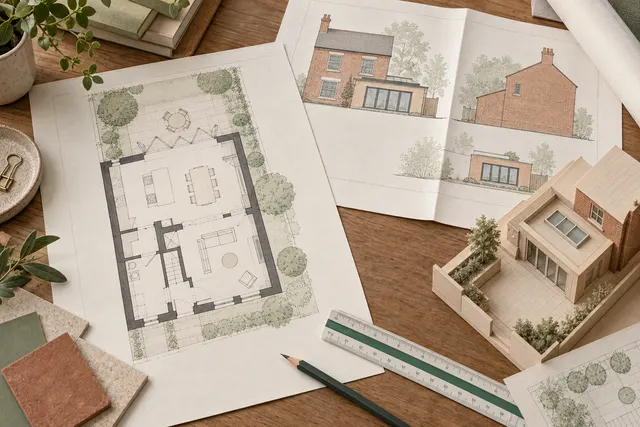
Read planning drawings, floor plans, elevations and sections. Use labelled diagrams, a drawing comparison table and revision checks to understand a proposal.
 PlanningTrack