In accordance with Paragraph 38 of the National Planning Policy Framework the Local Planning Authority has worked with the applicant in a positive and proactive manner to approve the proposed development, which accords with the Local Plan and the National Planning Policy Framework.
Pre-commencement Statutory Biodiversity Net Gain Condition The effect of Paragraph 13 of Schedule 7A to the Town and Country Planning Act 1990 is that, subject to some exemptions, every grant of planning permission in England is deemed to have been granted subject to the biodiversity gain condition that development may not begin unless: (a) a Biodiversity Gain Plan has been submitted to the planning authority, and (b) the planning authority has approved the plan. This objective is for development to deliver at least a 10% increase in biodiversity value relative to the pre-development biodiversity value of the onsite habitat. This increase can be achieved through onsite biodiversity gains, registered offsite biodiversity gains or statutory biodiversity credits. Based on the information available this permission is considered to be one which WILL require the approval of a Biodiversity Gain Plan before development is begun because none of the statutory exemptions or transitional arrangements are considered to apply. There are statutory exemptions and transitional arrangements which mean that the biodiversity gain condition does not always apply. These can be found at Biodiversity net gain: exempt developments - GOV.UK (www.gov.uk). The Planning Authority, for the purposes of determining whether to approve a Biodiversity Gain Plan in respect of this permission is Cannock Chase District Council. When submitting an application to discharge the biodiversity gain condition, the LPA requests that the applicant uses the standard national templates for a Biodiversity Gain Plan and a Habitat Management and Monitoring Plan. Submit a biodiversity gain plan - GOV.UK (www.gov.uk) The Biodiversity Gain Plan should be submitted as an ‘application for approval of details reserved by condition following grant of planning permission’ via the Planning Portal. The biodiversity gain condition cannot be removed or varied. Development to Proceed in Phases Where the permission granted has the effect of requiring or permitting the development to proceed in phases, the modifications in respect of the biodiversity gain condition which are set out in Part 2 of the Biodiversity Gain (Town and Country Planning) (Modifications and Amendments) (England) Regulations 2024 apply. In summary: Biodiversity Gain Plans are required to be submitted to, and approved by, the planning authority before development may be begun (the overall plan), and before each phase of development may be begun (phase plans). Biodiversity net gain - GOV.UK (www.gov.uk) Irreplaceable Habitat If the on-site habitat includes irreplaceable habitat (within the meaning of the Biodiversity Gain Requirements (Irreplaceable Habitat) Regulations 2024) there are additional requirements for the content and approval of Biodiversity Gain Plans. Irreplaceable habitats - GOV.UK (www.gov.uk) Effect of Section 73D of the Town and Country Planning Act 1990 If planning permission is granted on an application made under Section 73 of the Town and Country Planning Act 1990 and a Biodiversity Gain Plan was approved in relation to the previous planning permission (“the earlier Biodiversity Gain Plan”) there are circumstances when the earlier Biodiversity Gain Plan is regarded as approved for the purpose of discharging the biodiversity gain condition subject to which the Section 73 planning permission is granted. Those circumstances are that the conditions subject to which the Section 73 permission is granted: i) do not affect the post-development value of the onsite habitat as specified in the earlier Biodiversity Gain Plan, and ii) in the case of planning permission for a development where all or any part of the onsite habitat is irreplaceable habitat the conditions do not change the effect of the development on the biodiversity of that onsite habitat (including any arrangements made to compensate for any such effect) as specified in the earlier Biodiversity Gain Plan. i) habitat (including any arrangements made to compensate for any such effect) as specified in the earlier Biodiversity Gain Plan.
In the case of any reserved matters, application for approval must be made not later than the expiration of three years beginning with the date on which this permission is granted; and The development to which this permission relates must be begun not later than 7-Aug 2028 or the expiration of two years from the final approval of the reserved matters or, in the case of approval on different dates, the final approval of the last such matters to be approved. Reason To comply with the requirements of Section 92 of the Town & Country Planning Act 1990.
No part of the development hereby permitted shall be commenced until approval of the details of access, layout, appearance, landscaping and scale ('the reserved matters') has been obtained from the Local Planning Authority. Reason The permission is in principle only and does not authorise development to commence until all 'the reserved matters' have been approved. To ensure compliance with the requirements of Section 92 of the Town & Country Planning Act 1990.
The development hereby permitted shall not commence until drainage plans for the disposal of foul and surface water flows have been submitted to and approved by the Local Planning Authority. Thereafter, the development shall be implemented in accordance with the approved details before the development is first brought into use. Reason To ensure that the development is provided with a satisfactory means of drainage as well as to prevent or to avoid exacerbating any flooding issues and to minimise the risk of pollution.
The development hereby permitted shall be carried out in accordance with the following approved plans: Location Plan Drawing No. SLP1 Block Plan (PROPOSED) Drawing No. BP2 Reason For the avoidance of doubt and in the interests of proper planning.
No plant or machinery shall be operated, no loading or unloading of vehicles and no movement of commercial vehicles to or from the site shall take place outside the hours of 08:00hrs. to 18:00hrs Monday to Friday and 08:00hrs to 13:00hrs Saturday. None of the above operations shall be carried out at any time on Sundays or Bank and Public Holidays. Reason To mitigate potential adverse impacts from construction noise on residential amenity.
Staffordshire County Council Highways Authority (i) Please note you require Section 184 Notice of Approval from Staffordshire County Council. The link below provides a further link to 'vehicle dropped crossings' which includes a 'vehicle dropped crossing information pack' and an application form for a dropped crossing. Please complete and send to the address indicated on the application form which is Staffordshire County Council at Traffic and Network Unit, Staffordshire Place 1, Wedgwood Building, Tipping Street, STAFFORD, Staffordshire, ST16 2DH. (or email to trafficandnetwork@staffordshire.gov.uk) https://www.staffordshire.gov.uk/Highways/licences/Vehicleaccess/VehicleAccessCrossings.aspx
Coal Authority (ii) The proposed development lies within a coal mining area which may contain unrecorded coal mining related hazards. If any coal mining feature is encountered during development, this should be reported immediately to the Mining Remediation Authority on 0345 762 6846 or if a hazard is encountered on site call the emergency line 0800 288 4242. Further information is also available on the Mining Remediation Authority website at: https://www.gov.uk/government/organisations/mining-remediation-authority
Understand planning application documents, officer reports and decision notices. Use a reading checklist, document table and worked example to inspect a case.
Understand pending consideration, approved, refused and withdrawn planning applications. Compare status labels and find the documents explaining each outcome.
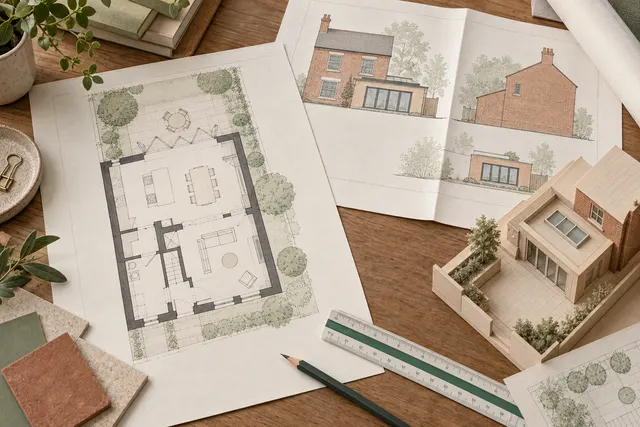
Read planning drawings, floor plans, elevations and sections. Use labelled diagrams, a drawing comparison table and revision checks to understand a proposal.
 PlanningTrack