Cannock Chase District Council hereby gives notice that PERMISSION IN PRINCIPLE HAS BEEN GRANTED for the carrying out of the above development in accordance with the details submitted or as may otherwise be amended following written approval by the Local Planning Authority. You are advised that an application for approval of Technical Details Consent (second stage) must be made not later than the expiration of three years beginning with the date of this permission.
The effect of paragraph 13 of Schedule 7A to the Town and Country Planning Act 1990 is that, subject to some exemptions, every grant of planning permission in England is deemed to have been granted subject to the biodiversity gain condition that development may not begin unless: (a) a Biodiversity Gain Plan has been submitted to the planning authority, and (b) the planning authority has approved the plan. This objective is for development to deliver at least a 10% increase in biodiversity value relative to the pre-development biodiversity value of the onsite habitat. This increase can be achieved through onsite biodiversity gains, registered offsite biodiversity gains or statutory biodiversity credits. There are statutory exemptions and transitional arrangements which mean that the biodiversity gain condition does not always apply. These can be found at Biodiversity net gain: exempt developments - GOV.UK (www.gov.uk). The Permission in Principle process is not exempt from the statutory Biodiversity Net Gain requirements therefore the statutory minimum information with regards to BNG (as detailed in paragraph 011 of PPG Biodiversity Net Gain) will be required for approval PRIOR to any technical details consent being granted, unless the applicant submits information to demonstrate that the development meets a valid exemption. This approach is confirmed by paragraph 003 of Planning Practice Guidance Biodiversity Net Gain which states: ‘The grant of permission in principle is not within the scope of biodiversity net gain (as it is not a grant of planning permission), but the subsequent technical details consent (as a grant of planning permission) would be subject to the biodiversity gain condition.’ The applicant should also note that where activities have been carried out on the site between 30 January 2020 and the date of the application which resulted in loss of onsite biodiversity value, the date used to calculate the site’s baseline biodiversity value should be immediately before these activities were carried out. Paragraph 036 of Planning Practice Guidance Biodiversity Net gain provides more information on this.
The proposal is in close proximity to protected trees and proposes significant works within root protection areas. In addition, pruning works will be required to facilitate access. In order to assess the acceptability of the proposal, an arboricultural impact assessment to BS5837-2012 will need to be submitted as part of the Technical Details Consent. This will need to take into account the abovementioned elements as well as the requirement for no dig surfacing, it’s impact on finished floor levels and -potentially- special foundation design if the proposal is within the root protection area of retained and protected trees. It will also need to take into account the long term relationship between the proposal and the trees and make adjustments to design and layout if necessary.
Understand planning application documents, officer reports and decision notices. Use a reading checklist, document table and worked example to inspect a case.
Understand pending consideration, approved, refused and withdrawn planning applications. Compare status labels and find the documents explaining each outcome.
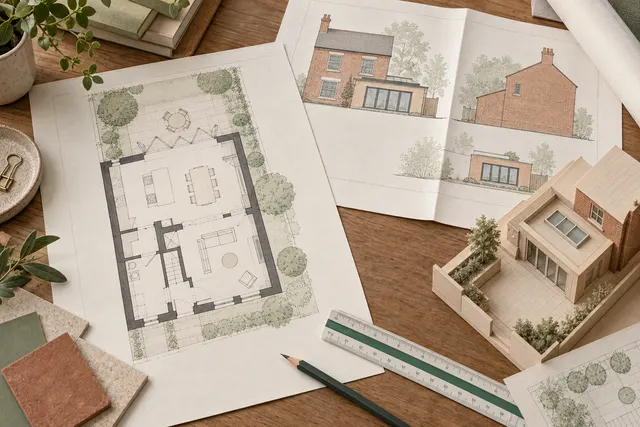
Read planning drawings, floor plans, elevations and sections. Use labelled diagrams, a drawing comparison table and revision checks to understand a proposal.
 PlanningTrack